The full label
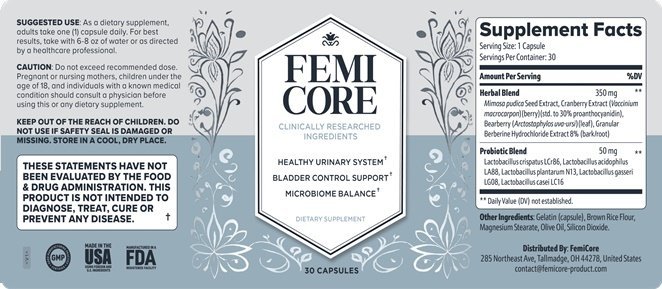
| Per 1 capsule | Amount |
|---|---|
| Herbal blend | 350 mg |
| Mimosa pudica seed extract | not disclosed |
| Cranberry extract (Vaccinium macrocarpon, berry), std. to 30% proanthocyanidins | not disclosed |
| Bearberry (Arctostaphylos uva-ursi, leaf) | not disclosed |
| Granular berberine hydrochloride extract 8% (bark/root) | not disclosed |
| Probiotic blend | 50 mg |
| L. crispatus LCr86, L. acidophilus LA88, L. plantarum N13, L. gasseri LG08, L. casei LC16 | not disclosed |
| Other ingredients | Gelatin (capsule), brown rice flour, magnesium stearate, olive oil, silicon dioxide |
Ingredient overview
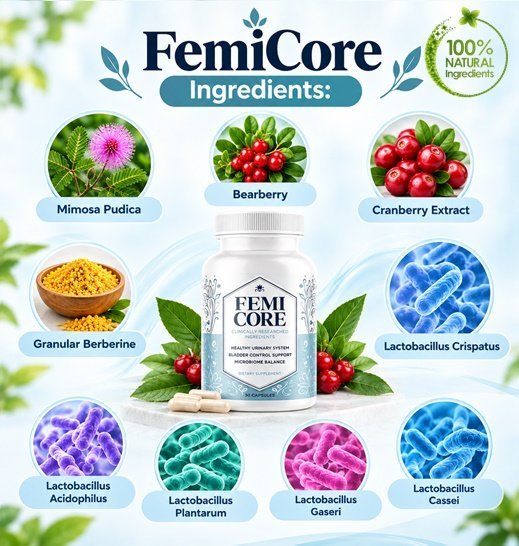
| Ingredient | Where on the label | Evidence snapshot |
|---|---|---|
| Mimosa pudica (seed) | Herbal, 350 mg blend | Traditional use; lab and animal studies only |
| Cranberry extract (30% PACs) | Herbal, 350 mg blend | Human trials for recurrent UTI risk |
| Bearberry / uva ursi (leaf) | Herbal, 350 mg blend | Traditional use for urinary symptoms; short-term only |
| Berberine HCl extract 8% | Herbal, 350 mg blend | Studied mainly for blood sugar and lipids |
| Lactobacillus crispatus LCr86 | Probiotic, 50 mg blend | Small vaginal-route trial for recurrent UTI |
| L. acidophilus LA88 | Probiotic, 50 mg blend | General probiotic research |
| L. plantarum N13 | Probiotic, 50 mg blend | General probiotic research |
| L. gasseri LG08 | Probiotic, 50 mg blend | General probiotic research |
| L. casei LC16 | Probiotic, 50 mg blend | General probiotic research |
What “proprietary blend” means for you
Supplement labels may list a blend’s total weight and its ingredients without giving each amount. FemiCore does this twice. The result:
- You can’t compare doses with studies. Cranberry, bearberry and berberine have all been studied at specific amounts; we can’t tell whether FemiCore reaches them.
- You can’t tell which ingredient dominates. Ingredients in a blend are usually listed in descending order by weight, which would suggest Mimosa pudica is the largest component, but the label doesn’t confirm this.
- The herbal total is small. 350 mg shared by four ingredients means each is, on average, under 90 mg.
What does “berberine HCl extract 8%” mean?
The label says “Granular Berberine Hydrochloride Extract 8% (bark/root)”. The most natural reading is an extract standardized to 8% berberine, but the label doesn’t define it. Either way, the berberine content is a fraction of a fraction of 350 mg. See berberine.
Why milligrams aren’t enough for probiotics
The NIH Office of Dietary Supplements explains that probiotic weight “can consist of both live and dead microorganisms” and has no relationship with the number of live microorganisms. It advises looking for the CFU (colony-forming unit) count at the end of shelf life. FemiCore lists 50 mg and no CFU. See other probiotic strains.
Thinking of trying FemiCore?
Check the seller’s current price and read the 60-day refund terms before you order. Talk to your doctor first if you take medication.
Affiliate link. Opens the seller’s official order page.The ingredients in detail
How the ingredients are meant to work together
The formula has two ideas:
- Make the urinary tract less hospitable to unwanted bacteria. Cranberry’s proanthocyanidins may reduce bacterial adhesion; bearberry’s arbutin has traditional antiseptic use; berberine shows antimicrobial activity in lab work.
- Encourage “friendly” bacteria. Lactobacilli, especially L. crispatus and L. gasseri, are common in a healthy vaginal microbiome, which sits close to the urethra.
That combination is logical. But no study has tested whether these particular ingredients, at these particular amounts, work together. Read how FemiCore works for the evidence chain.
Safety at a glance
| Ingredient | Main caution |
|---|---|
| Berberine | Digestive upset; may lower metformin levels (goldenseal study); avoid in pregnancy and breastfeeding |
| Bearberry | Short-term use only in EU guidance; avoid in pregnancy, kidney disorders, under 18 |
| Cranberry | Conflicting evidence on warfarin interaction |
| Probiotics | Caution in severe illness or weakened immunity |
| Mimosa pudica | Limited human safety data; antifertility activity reported in animal research |
Full details: FemiCore side effects.
What’s not in FemiCore
The label lists no stimulants and the seller calls the formula non-GMO. It contains no D-mannose, no pumpkin seed extract and no vitamins or minerals, which some other bladder products use. It does contain gelatin, so it is not vegetarian.
Frequently asked questions
What are the main ingredients in FemiCore?
A 350 mg herbal blend of Mimosa pudica, cranberry, bearberry and berberine, and a 50 mg blend of five Lactobacillus probiotics.
Which FemiCore ingredient has the most evidence?
Cranberry, which a 2023 Cochrane review found probably reduces repeat UTIs in women with recurrent infections.
How many CFU are in FemiCore?
The label does not say. It lists the probiotic blend as 50 mg.
Does FemiCore contain D-mannose?
No. D-mannose is not on the FemiCore label.
Ready to compare packages?
Order only through the seller’s checkout so your purchase is covered by the 60-day refund policy.
Affiliate link. Opens the seller’s official order page.Sources
- NIH Office of Dietary Supplements: Probiotics fact sheet for health professionals
- Cochrane: Cranberries for preventing urinary tract infections (2023)
- European Medicines Agency: Community herbal monograph on Arctostaphylos uva-ursi leaf (superseded revision 1)
- NCCIH: Goldenseal (berberine section)
- NCCIH: Cranberry
- NCCIH: Probiotics – what you need to know
- Sanaye MM, Joglekar CS, Pagare NP. Mimosa – a brief overview. J Pharmacogn Phytochem. 2015;4(2):182-187
Keep learning
*These statements have not been evaluated by the Food and Drug Administration. FemiCore is not intended to diagnose, treat, cure or prevent any disease. Information on this page is for education only. If you have bladder symptoms such as pain, blood in the urine, fever or sudden changes, see a health care professional.